For as long as anyone has been selling property in this pocket of the Upper Valley, listings have leaned on a specific phrase: irrigation rights from the Rio Grande. It shows up on vacant lots, on custom estates, on the half-acre parcels that ring the golf course. It reads like an amenity, something between a pool and a view. As of July 1, 2026, it is no longer just marketing copy. Texas now requires sellers to put that claim into a signed, standalone disclosure form, and the paperwork asks questions the listing description never had to answer.
That change matters more here than almost anywhere else in El Paso, because this is one of the few neighborhoods in the city where the phrase is actually true on a meaningful number of lots, and where it explains something real about how the streets look. It also means a decades-old selling point now has to survive documentation, and the documentation exposes gaps between what buyers assume the right delivers and what it actually does.
Why This Neighborhood Has Grass When the Rest of the City Doesn't
El Paso Country Club sits in the Upper Valley, and Texas water law here runs on a doctrine called prior appropriation, summarized as first in time, first in right. The oldest claims get priority when water runs short. Surface water from the Rio Grande is allocated through the El Paso County Water Improvement District No. 1, and because that river is shared with New Mexico and Mexico under an international treaty, availability shifts with flow and reservoir levels in any given year. Groundwater, by contrast, comes from the Hueco Bolson and Mesilla aquifers and is managed separately by the city's water utility, which regulates pumping to slow a decline that's been underway for years.
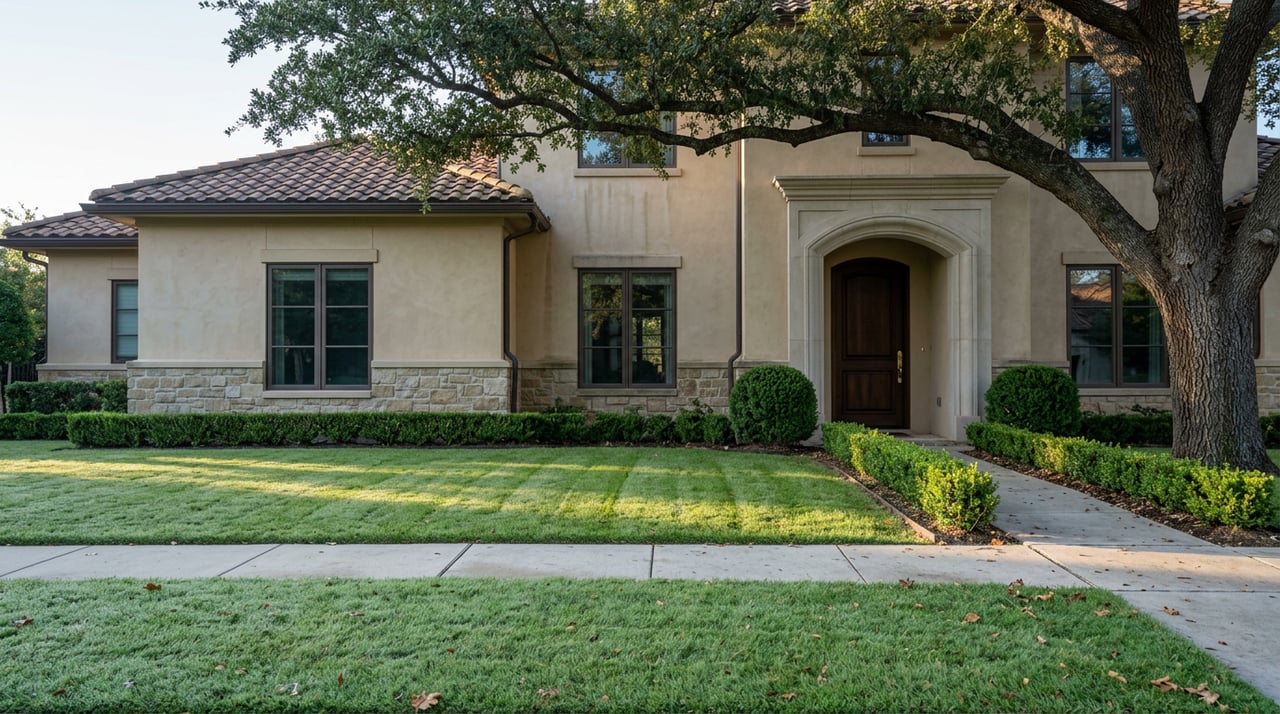
Most El Paso properties only have access to the second kind of water. A smaller number of older parcels, concentrated in places like the Upper Valley, carry a separate irrigation water service that delivers untreated canal water for landscaping at a lower cost than treated city supply. That's the mechanism behind the grassy front lawns that set this neighborhood apart from the xeriscape that dominates most of El Paso. It's also why the phrase keeps appearing in listing copy here specifically, on the El Paso Country Club parcels and in nearby streets, and rarely anywhere else in the city.
What the phrase doesn't say out loud is that the canal only runs roughly March through October, and even then, delivery isn't guaranteed every year. A right to irrigation water is not the same as a standing supply of it. In a low-flow year, a homeowner with irrigation rights still waters with potable city water, at potable city prices, same as anyone else in town.
The Buyback Program That Reveals What the Right Is Actually Worth
There's a second detail that rarely makes it into a listing at all. El Paso Water runs a voluntary program that lets owners who don't use their irrigation water lease those rights back to the utility. Under that arrangement, the utility pays the owner's annual water-rights tax for the lease term, covers any taxes already owed at signing, and pays a one-time lump sum of $2,500 per acre, prorated, within 60 days of signing. The lease runs with the land for 75 years and is only available to owners within El Paso city limits who hold rights on properties served by the district.
That program tells you something the marketing language never will: irrigation rights have a cash value separate from the house sitting on top of them, and that value can be extracted before a property ever hits the market. A seller who leased those rights away five years ago has nothing left to convey, no matter what the original plat says. A buyer who assumes "irrigation rights" means the acreage still carries an active, usable water right has to confirm that, not infer it from an old listing description.
What Changed on the Contract
Texas didn't create a new water right in 2026. It created a new paper trail. The Texas Real Estate Commission adopted Form 61-0, the Water Notice: Seller's Disclosure About Groundwater and Surface Water Rights, on May 4, 2026, with a mandatory effective date of July 1, 2026, following direction from the Sunset Advisory Commission's review of TREC's disclosure requirements. The form attaches through Paragraph 7 of most standard TREC contracts, with an exception carved out for the Residential Condominium Contract.
A seller only escapes the requirement if every statement in the contract's exception clause is true, including that there's no well on the property, whether in use or not, and no pond, lake, or water tank located on the property itself. A lake bordering the parcel doesn't count toward that exception, and a river running through the land isn't relevant to it either, according to TREC's own guidance on the form. Given how many Upper Valley lots carry a documented surface water right, a well, or a pond as part of the landscaping, a meaningful share of sellers in this neighborhood won't qualify for the exception and will need to complete the disclosure honestly and completely. TREC has been clear that leaving sections blank isn't an option, and that sellers with questions about whether groundwater rights have been severed, sold, or leased should talk to a private attorney rather than guess.
The disclosure itself isn't a warranty. It's a snapshot of what the seller knows on the day they sign it. But it puts a specific, dated claim into the file, in a market where that claim used to live only in a listing agent's description.
Proof the Water Doesn't Manage Itself
If there's any doubt that water delivery in this footprint takes active engineering rather than passive assumption, El Paso Country Club's own grounds settled that question. The club's irrigation system had been failing for years, with wet and dry spots and steady leakage across the course. Superintendent Tyler Bryson arrived in 2022 and spent two years living with the old system before a new one, designed by Jeff Good of Irrigation Services LLC and installed by Chris Harz of Heritage Links, went in using a dual-source configuration that draws from city water, wells and ponds, and the Rio Grande. The project was completed in 2024, after Winsupply Irrigation & Landscape's Loren Dunlap spent years building the case for it internally.
"The old system was failing," Dunlap said of the club's prior setup.
If the club itself needed a multi-year engineering project to reliably route three different water sources across its own acreage, a homeowner a few streets away shouldn't assume a decades-old irrigation right just works without anyone checking on it. The broader Upper Valley's water infrastructure has drawn outside attention too. El Paso Matters reported in April 2026 that El Paso Water purchased a 300-acre Upper Valley property without inspecting a 117-year-old dam on the site that is now at risk of failing, a reminder that the region's water systems are old, actively managed, and occasionally surprising even to the utility that runs them.
What This Changes If You're Transacting Here
If you're selling, don't wait until closing to find out what your parcel's water status actually is. Confirm with the El Paso County Water Improvement District No. 1 whether the right is currently assessed and in good standing, and check whether a prior owner already leased or sold it through the utility's buyback program. Decide, before you list, whether you want to keep the right as a selling point or whether cashing it out first makes more sense for your situation. Either way, complete Form 61-0 accurately. It doesn't replace your standard seller's disclosure notice, it sits alongside it.
If you're buying, treat "irrigation rights" as a line item to verify, not a feature to assume. Ask specifically whether the right is active on that parcel, when it was last used, and whether it's actually being conveyed at closing. Budget your landscaping costs as if potable water could be your only source in a low-flow year, because it might be. If the property has a well, a pond, or documented surface rights, expect the seller to complete the water disclosure, and read it as closely as you'd read a survey.
For a broader read on how this micro-market has been pricing and moving in 2026, our El Paso Country Club housing market snapshot covers the supply and timing side of the equation.
FAQ
Does this apply if my El Paso Country Club home doesn't have irrigation rights? The form still has to be completed if you don't meet every condition in the contract's exception clause, which includes questions about wells and on-property ponds or water tanks, not just irrigation rights specifically.
Does the new water disclosure replace the standard Texas seller's disclosure notice? No. The Property Code 5.008 disclosure and the new water notice are governed by different rules, and there are situations where one is required, both are required, or neither applies. They're separate documents with separate triggers.
What if I'm not sure whether my property's water rights have ever been sold or leased? Say so accurately on the form and consult a real estate attorney if you have specific doubts. The disclosure asks what you're aware of, not for a legal determination you're not equipped to make on your own.
Water rights are one more detail that separates a smooth Upper Valley closing from a delayed one. If you're weighing a sale in El Paso Country Club and want a clear picture of where your property stands, Cornerstone Realty can walk through it with you. Request your free home valuation and we'll start with the questions the new disclosure form is going to ask anyway.